
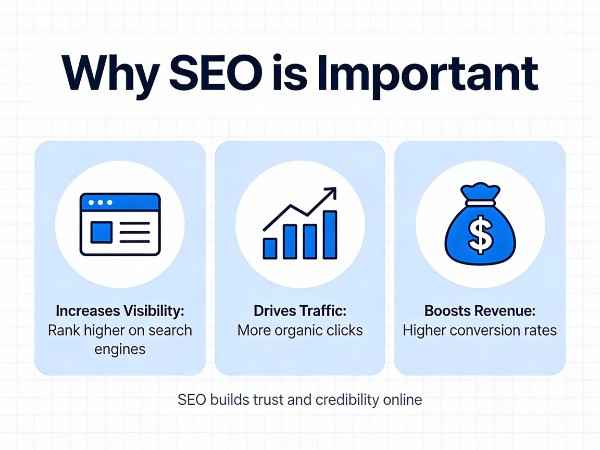
Overview of SEO
That foundation depends on content. Search engines reward substantive content and helpful content created through thoughtful content creation. I always aim for excellent content, high-value content, and robust content, supported by smart content promotion. Using the right language to give clear answers is what separates pages that exist from pages that perform.
Benefits of SEO
When I first started working in digital marketing, I quickly realized that SEO or search engine optimization is not optional—it’s essential. One of the biggest benefits of SEO is how it helps companies and their teams use resources and money more effectively in marketing activities. By focusing on SEO, you can improve web traffic, generate leads, and even make sales without relying solely on paid ads. Over time, I’ve seen sites that rank higher in Google’s organic page ranking gain more visibility, which directly impacts prospects finding your site and converting into customers.
Improving Visibility and Rankings
The most important function of SEO is increasing visibility. Higher rank on the search engine result page (SERP) ensures more prospects see your content, blogs, and landing pages. Updating information, statistics, and influencer statistics regularly can push a top performing blog or page, like the DMI blog I worked on, to the top spot, improving efforts and engaging more web users. According to The 2024 State of Marketing & Trends Report, nearly a quarter of users never scroll past the first SERP, highlighting why strong rankings are critical.
Driving Traffic and Organic Results
Traffic grows when organic results attract clicks. Moving from lower positions to the top five positions requires solid SEO practices. Using Featured Snippets from a blog or landing page to answer queries like how to convert AU size to UK size can boost click-through rate. Combining content marketing, paid media, and agency support like Neil Patel Digital further strengthens organic page ranking and maximizes visibility. Even small improvements in CTR can create significant opportunities, as Backlinko research confirms.
Building Authority with Page Authority
Strong Page Authority (PA) makes your site trustworthy, high quality, relevant, and valuable. Following Google E-E-A-T fundamentals ensures your content is credible. Using tools like Moz to track scores, earning backlinks from reputable domains, and reducing spam all contribute to stronger authority. From my experience, focusing on PA not only improves rankings but also builds long-term credibility with prospects and users.
Enhancing Customer Experience
On-page SEO is critical for a seamless customer experience. Optimizing usability for mobile visitors, laptop, and desktop users improves page load speed, reduces bounce rate, and increases conversions. Mapping the customer journey and evaluating each touchpoint ensures users can navigate your site easily and engage with your content without distractions or pop-ups. A smooth experience keeps prospects coming back and strengthens your brand.
Delivering Useful Solutions
The key to successful SEO is providing solutions that are genuinely useful to your prospects. Well-crafted content, blogs, and landing pages answer queries while following effective SEO practices. Focusing on goals, traffic, and leads ensures your site ranks high in Google and builds lasting relationships with users. From my perspective, a useful solution is just as important as visibility because it creates value beyond clicks.
Optimizing for Click-Through and Engagement
Securing Featured Snippets and improving click-through rate is vital. I’ve seen how minor updates in content, statistics, or information can move a page from the #10 position to number one, resulting in exponential gains in web traffic. Careful evaluation of SEO practices ensures your site remains competitive, valuable, and attractive to prospects.
Combining Authority, Traffic, and Experience
The best SEO strategies combine authority, traffic, and customer experience. By following fundamentals, leveraging tools, and monitoring scores, experts make sites trustworthy, relevant, and high quality. Every prospect or user benefits from a seamless, engaging experience, which boosts conversions, strengthens your brand, and achieves your marketing goals.
What are the 5 Crucial Elements of SEO?
Content
From hands-on work, I’ve learned that content is the vital part of any SEO strategy because it helps search engines understand meaning while you engage audiences naturally. When you create content using proper research and real insights, aligned with search intent, you answer user queries, cover strong website topics, and attract prospects searching for products and services, which steadily improves online visibility and keeps driving traffic over time.
Keywords
Using keywords correctly turns effort into real business value by balancing search rates with low competition, a method supported by Backlinko. A strong strategy structures terms as short-tail keyword, long-tail keywords, and local keywords, where each page targets a primary keyword or seed keyword, supported by secondary keywords and tertiary keywords. Smart keywords placement in URLs improves click-through rate and CTR while staying aligned with Google AI algorithms. Through keyword research and keyword analysis, you measure keyword difficulty, overall difficulty levels, search volume, and monthly search volume. Choosing long-tail keywords—specific multi-word phrases—often performs better than broad terms like biotech, with focused phrases such as biotech startup converting higher. Tools like Semrush and a clear keyword overview support on-page SEO, ongoing research, and cross-niche targeting from law firms to e-commerce, all reinforced by structured content, unique content, and regular technical maintenance as part of a complete SEO strategy.
Off-Page SEO
Strong rankings don’t happen without off-page SEO, which focuses on external optimization beyond your site. Building quality backlinks from an authoritative domain increases authority, and even a single mention from Forbes or New York Times can outweigh dozens of weak links. Tactics like guest blogging and influencer marketing work best when combined with solid on-page SEO, creating trust signals that search engines value.
Local SEO
For growth on the ground, local SEO is critical for local businesses targeting nearby users. With rising voice search on mobile devices and assistants like Alexa, searches like near me searches rely on strong local reviews, a complete Google My Business profile, accurate directory listings such as Yelp, a mobile-optimized website, helpful local content, and active social media engagement to capture local demand.
Search Engine Marketing
Search Engine Marketing through SEM supports SEO by adding speed with paid marketing. Channels like search advertising, PPC marketing, display ads, remarketing, shopping ads, video ads, programmatic ads, and affiliate marketing combine organic tactics and paid tactics when paired with optimized landing pages built for the right target audience, a space where rising online ad revenue trends are clearly shown by Statista.
What Impact is AI Having on Search and SEO
In today’s fast-changing digital marketing landscape, AI plays a crucial role in improving SEO strategies. Tools like ChatGPT and Advanced Data Analysis allow you to upload lists of keywords, analyze them, and brainstorm long-tail keywords or blog topics that help your business compete. While AI-generated content can refine content creation, experience, expertise, authoritativeness, and trustworthiness remain essential. Users value human insight and first-hand involvement, which cannot be fully replicated by artificial intelligence. Over the years, I’ve seen the combination of AI tools with technical SEO and ethical SEO practices deliver consistent results.
From what I’ve seen in real projects, AI and advances in AI have pushed search engines to rely on advanced algorithms, which is why SEO and search are constantly changing. Instead of pure keyword matching, Google now focuses on semantic search, reading context, behavior, and customer intent, which improves understanding intent behind real search queries. This shift forces SEO to move beyond basic keywords and focus on meaning, words, and concepts rather than surface-level signals.
This change started with RankBrain, an AI algorithm launched in 2015, which helped Google connect words to concepts, and later expanded with BERT, a natural language AI system that understands how word combinations express different meanings and intents. Then came MUM, built for deeper understanding language and even generating language. Today, Google Search Generative Experience or SGE has reshaped SERPs through a major visual change, delivering detailed search results that offer exact information to users, often as enhanced featured snippets, a shift widely discussed by Search Engine Land and shown in many screenshot examples of SGE results in Google search.
To optimize SEO for AI on search engines, I’ve learned it’s smarter to prioritize intent targeting over keyword targeting, and build content around key topics that truly tap into intent. Using multiple content types like blogs, videos, podcasts, and webinars helps reach audiences and get ranked, especially when you apply Google E-E-A-T principles of experience, expertise, authoritativeness, and trustworthiness to apply to content. Add voice search, more conversational content, solid technical SEO with link building and site speed, a seamless user experience, and align content across channels to stay competitive.
Use SEO to Drive Traffic & Generate Quality Leads
If you want your company and content to be seen by the right people, understanding how to use effectively both organic SEO and paid SEO is crucial. Over time, I’ve noticed that businesses often miss steps to drive traffic or generate quality leads because they don’t focus on customer intent or searcher intent. Using SEO efforts wisely allows your website and landing page to reach users who truly need or want your product or service, making your strategy more successful. Learning from experts like Neil Patel, a search marketing guru, and taking a certified search marketing course can help explore the fundamentals, demand generation, search analytics, and overall search strategy, ensuring you get started on the right path in updated 2024 methods.
The Role of SEO in Digital Marketing
Understanding SEO is vital for every website. From technical factors like site architecture, website speed, mobile optimization, markup, implementation, URL structures, alt text, headings, meta-data, and semantic HTML, to content work and link building, everything contributes to organic rankings and traffic. Proper troubleshooting of indexing issues and Googlebot crawl ensures your pages are discoverable by search engines like Google, improving relevancy, topic focus, and overall SEO success. My experience shows that websites optimized for mobile-first indexing perform better with internet users on mobile devices, giving a significant boost to modern SEO efforts.
Should I Have an SEO Strategy
Yes! A clear, intentional, data-driven SEO strategy is essential for digital marketing success. Keyword research, content creation, and technical optimization must work together to increase visibility, traffic, and quality leads. Over time, ethical SEO, patient growth, and a data-driven approach produce organic search results that customers trust. Without a strategy, even expertise, authoritativeness, and credibility might not translate into results or business growth.
How SEO Can Boost Your Business
SEO enhances brand trust and user experience (UX) by making your website an authoritative source. When your site ranks on page one or in the top three results, customers are more likely to convert. Organic search results build trust through relevancy and authoritative content, while paid ads like PPC, bids, placement, impressions, CPM, or call-only ads can supplement but not replace organic SEO. I’ve seen businesses grow sustainably when SEO focuses on both technical SEO and valuable content that addresses user intent.
Improving User Experience
Technical SEO directly impacts user experience. Website speed, load times, responsive design, tap targets, site navigation, internal link structure, and URL structures ensure visitors interact seamlessly with your website. Combining these elements with content creation and backlinks increases web clicks, traffic, and overall engagement. Positive UX strengthens trustworthiness and improves SEO success, showing search engines that your site provides value to users.
Lead Generation and Local SEO
One of the main benefits of SEO is lead generation. By using relevant keywords with intent, you attract pre-qualified leads to your offerings. Local SEO focuses on geographic queries, local intent, and optimizing Google Business Profile, helping you reach prospects in specific cities and towns. This targeted approach increases traffic, conversion, and trust while maintaining authoritative presence in your industry.
Paid vs Organic Searches
It’s important to know the difference between paid search and organic search. Paid ads can include PPC, CPM, call-only ads, and advertising on SERPs. These can quickly generate traffic but require an ad budget and ongoing management. Organic SEO, on the other hand, builds long-term authority, brand trust, and visibility without continuous spending. Combining paid search with organic search enhances your overall digital marketing strategy and maximizes results.
Contact Us Today for Your SEO Digital Marketing Needs
If your business wants to improve SEO success, boost organic rankings, or generate quality leads, it’s crucial to integrate technical SEO, content creation, and digital marketing strategy effectively. With careful analysis, research, and implementation, your website can attract customers, increase traffic, and achieve measurable results. In my experience, combining AI tools, ethical SEO, and human insight creates the most valuable outcomes for any business.
Conclusion: Search Engines Are Fallible
Even the most advanced search engines are fallible and not perfect. I’ve experienced cases where a site with a proper link structure still fails to crawl or index properly due to coding errors or non-textual content like images, flash, audio files, or video. Duplicate content, forms, and common areas of problems can also block your rank or lower rankings, which shows why every element of SEO must be carefully understood. Focusing on relevant content and valuable content aligned with language and semantics ensures your website doesn’t pay the price of these failings.
By combining the right SEO efforts with a clear understanding of search engines, businesses can develop strategies that truly use effectively all the tools available. Knowing how to focus on site elements of SEO, from structure to content, gives you an edge over competitors. Proper SEO allows you to rank higher in search results, drive traffic, and ultimately generate quality leads while catering to both customer intent and searcher intent. It’s about making sure every time you invest in SEO efforts, you maximize impact, create relevant content, and ensure your company and site reach the people who need and want your product or service.
FAQs
How important is SEO really?
SEO is important because search engines are not perfect and often imperfect, so without the right steps, your website can pay the price. When a site has weak structure or broken links, search engines may fail to crawl it properly, affecting crawling, index, and indexing, which leads to lower rankings and poor overall rankings. A common example is missing a proper link structure, where pages are hard to index, and SEO helps counter these failings by making the website easier to understand and navigate, showing the real importance of SEO in long-term growth.
What are the 4 Pillars of SEO?
Keywords, Content, Off-Page SEO, Local SEO, Search Engine Marketing
What are the 4 pillars of SEO? The 4 pillars of SEO are the main SEO pillars that help search engines, search engine crawlers, and robots clearly understand a website while keeping humans in focus through a strong user experience. Why is SEO considered a complex endeavor? Because optimizing your website is a complex endeavor that requires the best way to align technical SEO, on-page SEO, useful content, and authority-building off-page SEO. How should SEO be handled effectively? The right approach is to break down efforts into manageable steps, ensuring proper website optimization that works naturally for both users and search systems.
What is the Main Focus of SEO?
In my experience, SEO or search engine optimization is all about making search engines and real users understand your content so they can easily find your site and feel confident about their decision to visit. Effective SEO is about helping users while also helping search engines understand content and find your site, guiding people to make a decision and visit your site through a search engine. It improves visibility, supports discovery, matches relevance with intent, strengthens accessibility and information retrieval, boosts online presence and website discovery, enhances search experience, encourages organic discovery, builds content understanding, guides the user journey, informs decision making, considers search behavior, maintains site relevance, ensures proper indexing and crawling, and leverages ranking signals to help your pages show up in search results.
What is the 80/20 Rule in SEO?
From my experience working on multiple websites, the 80/20 rule in SEO, also called the Pareto Principle, shows that 80% of your desired results like traffic, leads, and sales often come from just 20% of your SEO efforts. This means not all pages, keywords, backlinks, or optimizations contribute equally. By identifying and focusing on high-impact activities, such as optimizing key landing pages and targeting high-value keywords, you can achieve disproportionately greater results without spreading your resources thinly across all SEO tasks. Over time, I’ve noticed that prioritizing these elements boosts results far more effectively than trying to improve everything at once.
What is more important in SEO?
In SEO, what matters most is balance: strong content quality with valuable information, original content, good readability, and clear relevance improves user experience, builds trust, authority, and engagement, and boosts search visibility, rankings, organic traffic, and overall website value based on Google ranking factors. At the same time, backlinks, inbound links, external links, smart link building, quality referring domains, and high link relevance strengthen website authority, trust signals, and ranking signals used by search engines. Matching search intent, user intent, and content relevancy through accurate query matching, understanding user needs, and aligning with SERP alignment improves satisfaction. Fast website loading speed, better page speed, mobile friendliness, clean website structure, proper keyword optimization, strong domain authority, and efficient crawling by search engine bots together decide long-term SEO performance.